Showing posts with label pizza. Show all posts

Thursday, February 21, 2019

A Visual Feast - Bromer Gallery, Boston, MA

21 February – 3 May, at the Bromer Gallery, 607 Boylston St, Boston, MA

Here's a selection of my books, fine bindings, linocuts, woodcuts, digital prints, calligraphy, and a watercolor you'll find on display.

Pizza from Scratch

"Burning Weeds" linocut from Pizza from Scratch


"Wheat – July" linocut from Pizza from Scratch

"Pepperoni Pizza" linocut from Pizza from Scratch

"Stock/1" woodcut from Chili: a recipe
"Stock/2" woodcut from Chili: a recipe


"Yellow Blackberryleaf flower" digital print from Florilegium Solmentes

John Keats poem "To Autumn", calligraphy (9 x 6ft) – also available in book form


"Grasmere", watercolor – details were used to illustrate William Wordsworth's The Prelude


Wordsworth The Prelude
For more information visit solmentes.com

The Bromer Gallery is a new gallery within Anne Bromer's bookstore at 607 Boylston St. in Boston, MA.

Monday, February 11, 2019

Dimitry Sayenko wins a Pepperoni Pizza at the Codex Book Fair

Solmentes Press is delighted to announce the winner of the prize draw at the Codex Book Fair in Richmond, California was fellow artist, printer and bookbinder, Dimitry Sayenko from Saint Petersburg, Russia. Поздравления Dimitry!

Dimitry Sayenko (Nikodim Press) with David Esslemont (Solmentes Press)

Dimitry won a signed copy of the limited edition linocut "Pepperoni Pizza" by David Esslemont from his book, Pizza from Scratch.


Prize Draw
To win a copy of the print, visitors to the Solmentes Press table at the Codex Book Fair (February 3–6) put their business card or name and email address in a bag from which a winner was drawn at the end of the fair. Read more about Pizza from Scratch and buy copies of the print ($300), visit solmentes.com.

Thanks to everyone who entered to win the print and for their interest in Solmentes Press.

Sunday, February 3, 2019

Win a Pepperoni Pizza Print!


Here is your chance to win an original limited edition signed print by David Esslemont – "Pepperoni Pizza" a multi-color linocut from Pizza from Scratch. 

To enter the draw you must visit the Codex Book Fair in The Craneway Pavilion, 1414 Harbour Way South, Richmond, CA 94804 between Sunday 3 and Wednesday 6 February. 

Go to the Solmentes Press (table #5 - in the front row opposite the main fair entrance) and place your business card in the box provided (or write your name and email address on a slip of paper). One winning entry will be drawn by an exhibitor from the book fair at the Codex Gala Dinner in the Berkeley City Club on Wednesday 6 February.

Good luck and enjoy what is sure to be a spectacular book fair. Full details of the Codex book fair and Symposium can be found on the Codex Foundation website.

Wednesday, January 17, 2018

Englishman makes pizza from scratch and sells recipe for $$$$

It all began with a dream of establishing a self-sufficient “Pizza Farm” business. 


Linocut: The pizza oven

Decorah, IA – Artist David Esslemont dreamt of establishing a “Pizza Farm”. He grew wheat and tomatoes and built a clay oven – but it just wasn’t feasible. However, he had another idea: a limited edition hand-printed book.

Pizza from Scratch, a visual narrative in woodcuts and linocuts, tells the story of how he literally grew a pizza on his farm in Iowa. With orders from distinguished institutions such as the Library of Congress and the British Library the book promises to be quite a success, and with copies selling for up to $4,800, it will help pay the heating bills this winter.


Weeds, fire, cultivating, seeds, seedlings, broadcasting, harrowing, harvesting, threshing and construction details are all depicted together with a diagram proving Pythagoras's theorem (used to make a right angle when laying out the foundation for the walls).

Esslemont grows the oven from scratch. Cement block walls support a reinforced concrete plinth and a layer of firebricks. He then makes adobe bricks with clay dug from his farm, and forms the oven around a mound of sand. After adding a layer of insulation, more clay bricks, a chimney, and a roof, it's ready to fire up.


As the oven takes shape, the artist appears in a number of self-portraits that reveal his growing obsession with the project. The book concludes with instructions for making the dough, cheese, and tomato sauce and cooking the pizza.

Let's Make Pizza linocut -1

Let's Make Pizza linocut - 4

Let's Make Pizza linocut - 3

Let's Make Pizza linocut -2

Finally, there is an extraordinary multi-color print of a pepperoni pizza.


Pepperoni Pizza linocut

Pizza from Scratch is published by Solmentes Press in a limited edition of 40 copies, 10.5 x 15 inches, landscape, 68pp. Thirty-six images together with a separate plan, printed from the original blocks. Five deluxe copies bound in white alum-tawed goatskin – $4,800, and thirty-five copies in cloth-covered boards – $2,400.

Full details and images on solmentes.com
Read the story behind the book here

Bio
David Esslemont is an artist, designer, printmaker and bookbinder who makes books from scratch, most recently about food, and published under his Solmentes Press imprint. He was Artistic Director of the University of Wales Gregynog Press from 1985–97 and has won many book design awards including the Felice Feliciano International Award in 1991. Esslemont’s work can be found in both private and public collections worldwide. (His archive to 2005 is held at the University of Iowa.)

###

Contact David Esslemont 563 419 8882 david (at) solmentes.com
Solmentes Press, 1990 Fox Hollow Road, Decorah, IA 52101

Tuesday, January 9, 2018

Pizza from Scratch – The story of a visual narrative

Pepperoni pizza linocut

I have an interest in food – okay it’s a passion – actually it’s an obsession: I am obsessed with food and cooking, today it's pizza cooked from scratch in a wood-fired oven. Some of my earliest memories of cooking date back to when I was a Boy Scout: delicious, smoky, crispy outside, soft inside “benders and twisters” – simple wheat flour dough balls stretched around a stick, cooked over a campfire.

Later, travels in Italy and the revelation that the Holy Trinity was in fact garlic, tomatoes and olive oil, and the best pizzas where cooked in wood-fired ovens, helped fuel this passion for cooking that become an obsession.

I want to know where my food has come from. If the food is processed, what are the ingredients and where did they come from? How were they grown/raised? I want to taste natural flavors, not chemicals; naturally ripened tomatoes, not bland, anemic imposters – I don’t want to worry about pesticide or herbicide residues. So, I grow fruit and vegetables following organic methods, and preserve as much as possible.

Uncut corn, Fox Hollow Road, Iowa, winter

In the first year after moving to Iowa we raised over a hundred tomato plants from seed, all heirloom varieties from Seedsavers Exchange (conveniently located just a couple of miles away). Before long we were supplying Seedsavers with seed. We grew peppers and cucurbits and learned what it felt like to be a peasant – my mother’s comment was, “well it’s in your blood you know!” But I am not a farmer, I’m an artist who makes books.

The garlic and basil thrived and I learned the rituals of canning – processing hundreds of pounds of tomatoes and other produce and preserving them in glass jars. This gave me the idea that I could grow all the toppings for pizzas and make and sell them, say, once a week.

Pizza farms are not uncommon in the Midwest and my main inspiration was Robbie Bannen and Ted Fisher’s AtoZ Bakery in Wisconsin that hosts a now famous "Tuesday Night Pizza" on their farm. I considered the feasibility of a pizza operation at our farm.

First pizza oven

Learning the art of the Pizzaiolo

In July 2011 I built a wood-fired oven and began making pizzas, little knowing how the project would evolve. I dug clay from a corner of a field and mixed it with sand to form Adobe bricks; then built a dome-shaped oven on a plinth constructed from heavy oak beams left over from our barn resizing. The hearth was made with reclaimed firebricks from a demolished school. Just days later we hosted a pizza party and cooked over a dozen pizzas – learning “on the job” the art of the pizzaiolo –forming the dough, preparing and applying judicious amounts of toppings and cooking at high temperatures in a wood-fired oven.

There is something magical about the wood-fired oven: the rolling flames, searing heat and tantalizing aromas are quixotic. If you’ve grown the ingredients, and harvested the tomatoes and basil that afternoon – the flavors will be out of this world.

Disaster strikes

On Saturday, May 12, 2012, the firebrick hearth was unusually hot and I noticed the 8 x 8-inch oak beam at the mouth of the oven was smoldering, again. The pizzas were unremarkable and the base of the crust, burnt.

Burned pizza oven

The next morning, our son Tom ran into the kitchen: “the pizza oven has collapsed, it’s burning!” He was right . . . my pride and joy was reduced to a heap of white-hot burning oak beams among which lay the hearth of recycled firebricks, topped by sherds of the shattered hard-baked adobe clay dome from which jutted the chimney flanked by the tin roof. Thank goodness I didn’t build it near the house. I was devastated.

Breaking ground for a new oven

In May 2014 I burned a field of weeds to clear it ready for planting spring wheat, and dug the foundations for another pizza oven. Cement block walls would support a reinforced concrete plinth, an insulated bed of new firebricks and the clay oven. As I documented its construction and the emerging wheat and tomato seedlings I conceived the idea for a new book.


Pizza from Scratch: the story of how I literally grew a pizza on the farm in rural Iowa. Wholly embracing the farm-to-table movement, I grow hard red wheat and Amish Paste heirloom tomatoes; design and build an adobe clay wood-fired oven (scale plans included); give instructions on how to make the dough, tomato sauce and mozzarella cheese; fire up the oven, assemble the pizza and cook it, in less than three minutes.

Following the success of my book Chili: a recipe this new book would also be a visual narrative in woodcuts and linocuts. My first image was a series of woodcuts, that together formed a panel six feet long, the subject: weeds. In due course this was reduced to just one page, fifteen inches wide and I settled on a landscape format chiefly to accommodate the subsequent twenty-four inch wide print of burning weeds as a double-page spread.

Burning weeds linocut, double page spread

I made thumbnail sketches for a storyboard, and began detailed studies and drawings from life and from photographs documenting the construction of the oven and the progress of the wheat and tomatoes. Then I began cutting blocks. [see blog post Pizza from Scratch – Part 2]

Pizza from Scratch: Now Available

As a bookbinder, I approach book design with the book’s final structure in mind and the best construction is a sewn gathering of folded sheets with the grain direction of the paper running parallel with the spine. I wanted most of the images to “bleed off” the trimmed page. Consequently the sheet size had to allow for a substantial margin around the prints (to hold the paper in place while printing) and was thirty-four inches long by fifteen inches high. This required a cunning set-up on the Ostrander Seymour “Extra Heavy” iron hand press as its platen is only twenty by seventeen inches and demanded extra care when handling such a large sheet.

Printing began in April 2017 and continued into June. While some images are just black and white, others are complex multi colour prints from three blocks that were cut and printed several times (reduction cutting). Printing fifty copies yielded an edition of forty books. All told I pulled 5,600 prints, not counting proofing and set up. The larger prints required double pulls and the more solid images were “hard pulls” that required an extension tube on the bar!

Pizza box

Binding

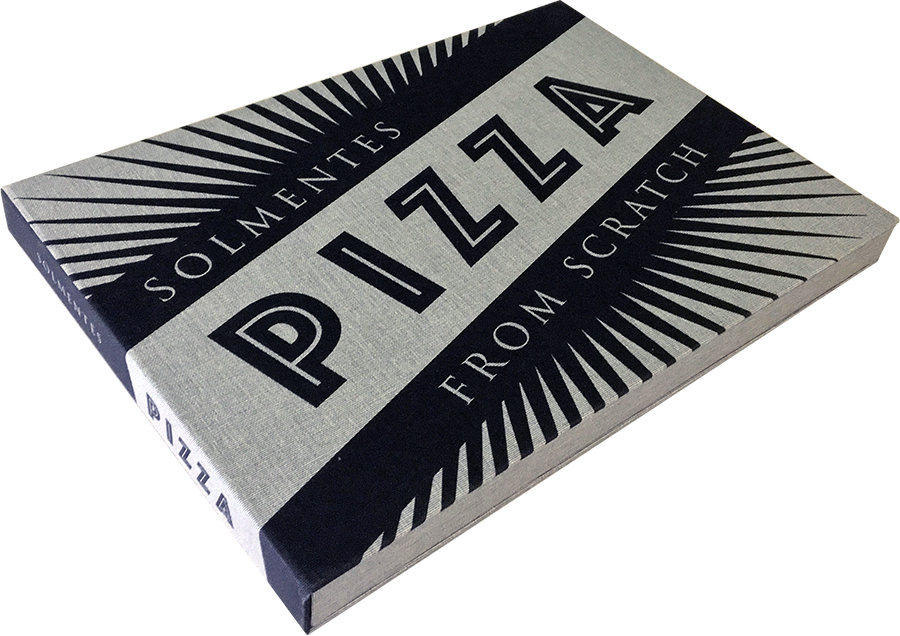
With the sorting, folding, gathering and collating I was able to clear some bench space in the workshop as the books were consolidated into three small piles. The book is offered in two variant bindings a “regular “ case binding and a “deluxe” full leather binding. Both bindings involve sewing by hand and each is presented in cloth-covered drop back box with the title printed on the spine and lid. Inserted into an envelope on the inside of the lid is a large folded print of the scale drawings for the oven.

I am pleased to report that “regular” Pizzas have been shipped to collectors in the US and the UK and I am particularly proud that both the British Library and the Library of Congress now have their copies. The deluxe bindings are almost finished.

Where to see Pizza from Scratch

A travelling exhibition is planned together with presentations and demonstrations and the book will be shown at book fairs in 2018 including the Manhattan Fine Press fair and the Oxford Fine Press Fair in March, and at the Oak Knoll Fest in Newcastle, Delaware in October. Full details of the book and all the images can be seen at solmentes.com

There is something magical about cooking in a wood-fired oven: the rolling flames, searing heat and tantalizing aromas are quixotic. If you’ve grown the ingredients, and harvested the tomatoes and basil that afternoon – the flavors will be out of this world.”


hot oven

***


Monday, March 7, 2016

Pizza from Scratch – Part 4


January 28–February 9: 'Burning Weeds', a hand printed, five-color lino cut, 24 x 12 inches.  At this stage neither the logistics of printing and binding or the format of the book have been resolved, but a page size of 10 x 12 inches (landscape) would accommodate this image as a double-page spread if trimmed to bleed.


Red, on orange on yellow,  and orange on yellow, 'wet on wet ink' proofs.


'Wheat Field', early morning, lino cut with watercolor wash, 24 x 12 inches. These double-page spreads convey the breadth of the landscape but printing them presents a challenge. Perhaps single-page images would make more sense . . . .


How about 12 x 7.5 inches? Here a close-up of the key block for a three-color lino cut, 'Cultivating' with the Massey Ferguson tractor.


This print of the key block is offset onto two other blocks, one each for red and green.


Obviously the Massey is red and the leaves and grass are green, where the two colours overlap they will produce a brown, ideal for the soil and tree trunks.


A first color proof shows how the red/green makes a brown, but it still needs work.


The wheat seeds viewed close up. This shows how the lino cut progresses, first cuts are rough outlines, followed by detailed hatching to add light and shade.


The finished block. For the book I might add a color wash or print black on a colored background.


Ten pounds of Glenn organic Spring wheat from Johnny's Selected Seeds in Maine where broadcast by hand.


To cover the seeds and compress the soil around them I drove around the field on the Kawasaki Mule dragging a vintage spike-tooth harrow. Two scarecrows and a totem pole will keep watch over the crop. (Key block)


Three-color lino cut with hand coloring. Now I wait for the seed to germinate and turn to the tomatoes which were planted earlier and may appear first in the book . . . . Read more in Pizza from Scratch – Part  5

Saturday, March 5, 2016

Pizza from Scratch – Part 3


January 12, 2015: Making adobe clay involves 'puddling' – the mixing of clay, sand and water with your feet, hence this pencil study. Drawing is an important discipline for the artist – daily practice is worthwhile. This post includes detailed studies as well as sketches for the illustrations to the Pizza book.


One of the main goals is to grow wheat for flour to make dough for the pizza. Here is a pencil drawing of an ear of Glenn organic Spring wheat grown on our farm here in Iowa.


The first step in preparing the field for planting was to burn last years weeds, with the hope that many of the weed seeds were also incinerated. At this point I began to think the book should be landscape format and this subject will become a double page spread lino cut.


Mixing cement and building concrete-block walls is hard, thirsty work, especially in the heat of the summer and the builder deserves a well-earned beer at the end of the day, especially when an important stage is completed. These walls will support a concrete plinth on which the oven will be built.


Wire mesh and tubing in place to reinforce the concrete slab.


Firebricks in position on top of an insulation layer, ready to build the sand dome around which the oven will be formed.


Drawing the sand dome to achieve the desired lighting was tricky.


My clay-covered hands forming the Adobe bricks.


Sharp-eyed viewers will observe the sand dome is covered with the Wall Street Journal. The newspaper is dampened and the hand-formed Adobe clay bricks are placed around the dome to form the first layer of the oven wall.


Preferred fuel: well-seasoned oak.

After almost three weeks drawing, it is time to embark upon a lino cut. Read more in the next post: Pizza from Scratch – Part 4

Podcast: David Esslemont on the history of the Gregynog and Solmentes Presses

Gregynog Hall Nigel Beale aka The Literary Tourist , came to visit and recorded our conversation in which he asked me about the history...