Tuesday, January 9, 2018

Pizza from Scratch – The story of a visual narrative

Pepperoni pizza linocut

I have an interest in food – okay it’s a passion – actually it’s an obsession: I am obsessed with food and cooking, today it's pizza cooked from scratch in a wood-fired oven. Some of my earliest memories of cooking date back to when I was a Boy Scout: delicious, smoky, crispy outside, soft inside “benders and twisters” – simple wheat flour dough balls stretched around a stick, cooked over a campfire.

Later, travels in Italy and the revelation that the Holy Trinity was in fact garlic, tomatoes and olive oil, and the best pizzas where cooked in wood-fired ovens, helped fuel this passion for cooking that become an obsession.

I want to know where my food has come from. If the food is processed, what are the ingredients and where did they come from? How were they grown/raised? I want to taste natural flavors, not chemicals; naturally ripened tomatoes, not bland, anemic imposters – I don’t want to worry about pesticide or herbicide residues. So, I grow fruit and vegetables following organic methods, and preserve as much as possible.

Uncut corn, Fox Hollow Road, Iowa, winter

In the first year after moving to Iowa we raised over a hundred tomato plants from seed, all heirloom varieties from Seedsavers Exchange (conveniently located just a couple of miles away). Before long we were supplying Seedsavers with seed. We grew peppers and cucurbits and learned what it felt like to be a peasant – my mother’s comment was, “well it’s in your blood you know!” But I am not a farmer, I’m an artist who makes books.

The garlic and basil thrived and I learned the rituals of canning – processing hundreds of pounds of tomatoes and other produce and preserving them in glass jars. This gave me the idea that I could grow all the toppings for pizzas and make and sell them, say, once a week.

Pizza farms are not uncommon in the Midwest and my main inspiration was Robbie Bannen and Ted Fisher’s AtoZ Bakery in Wisconsin that hosts a now famous "Tuesday Night Pizza" on their farm. I considered the feasibility of a pizza operation at our farm.

First pizza oven

Learning the art of the Pizzaiolo

In July 2011 I built a wood-fired oven and began making pizzas, little knowing how the project would evolve. I dug clay from a corner of a field and mixed it with sand to form Adobe bricks; then built a dome-shaped oven on a plinth constructed from heavy oak beams left over from our barn resizing. The hearth was made with reclaimed firebricks from a demolished school. Just days later we hosted a pizza party and cooked over a dozen pizzas – learning “on the job” the art of the pizzaiolo –forming the dough, preparing and applying judicious amounts of toppings and cooking at high temperatures in a wood-fired oven.

There is something magical about the wood-fired oven: the rolling flames, searing heat and tantalizing aromas are quixotic. If you’ve grown the ingredients, and harvested the tomatoes and basil that afternoon – the flavors will be out of this world.

Disaster strikes

On Saturday, May 12, 2012, the firebrick hearth was unusually hot and I noticed the 8 x 8-inch oak beam at the mouth of the oven was smoldering, again. The pizzas were unremarkable and the base of the crust, burnt.

Burned pizza oven

The next morning, our son Tom ran into the kitchen: “the pizza oven has collapsed, it’s burning!” He was right . . . my pride and joy was reduced to a heap of white-hot burning oak beams among which lay the hearth of recycled firebricks, topped by sherds of the shattered hard-baked adobe clay dome from which jutted the chimney flanked by the tin roof. Thank goodness I didn’t build it near the house. I was devastated.

Breaking ground for a new oven

In May 2014 I burned a field of weeds to clear it ready for planting spring wheat, and dug the foundations for another pizza oven. Cement block walls would support a reinforced concrete plinth, an insulated bed of new firebricks and the clay oven. As I documented its construction and the emerging wheat and tomato seedlings I conceived the idea for a new book.


Pizza from Scratch: the story of how I literally grew a pizza on the farm in rural Iowa. Wholly embracing the farm-to-table movement, I grow hard red wheat and Amish Paste heirloom tomatoes; design and build an adobe clay wood-fired oven (scale plans included); give instructions on how to make the dough, tomato sauce and mozzarella cheese; fire up the oven, assemble the pizza and cook it, in less than three minutes.

Following the success of my book Chili: a recipe this new book would also be a visual narrative in woodcuts and linocuts. My first image was a series of woodcuts, that together formed a panel six feet long, the subject: weeds. In due course this was reduced to just one page, fifteen inches wide and I settled on a landscape format chiefly to accommodate the subsequent twenty-four inch wide print of burning weeds as a double-page spread.

Burning weeds linocut, double page spread

I made thumbnail sketches for a storyboard, and began detailed studies and drawings from life and from photographs documenting the construction of the oven and the progress of the wheat and tomatoes. Then I began cutting blocks. [see blog post Pizza from Scratch – Part 2]

Pizza from Scratch: Now Available

As a bookbinder, I approach book design with the book’s final structure in mind and the best construction is a sewn gathering of folded sheets with the grain direction of the paper running parallel with the spine. I wanted most of the images to “bleed off” the trimmed page. Consequently the sheet size had to allow for a substantial margin around the prints (to hold the paper in place while printing) and was thirty-four inches long by fifteen inches high. This required a cunning set-up on the Ostrander Seymour “Extra Heavy” iron hand press as its platen is only twenty by seventeen inches and demanded extra care when handling such a large sheet.

Printing began in April 2017 and continued into June. While some images are just black and white, others are complex multi colour prints from three blocks that were cut and printed several times (reduction cutting). Printing fifty copies yielded an edition of forty books. All told I pulled 5,600 prints, not counting proofing and set up. The larger prints required double pulls and the more solid images were “hard pulls” that required an extension tube on the bar!

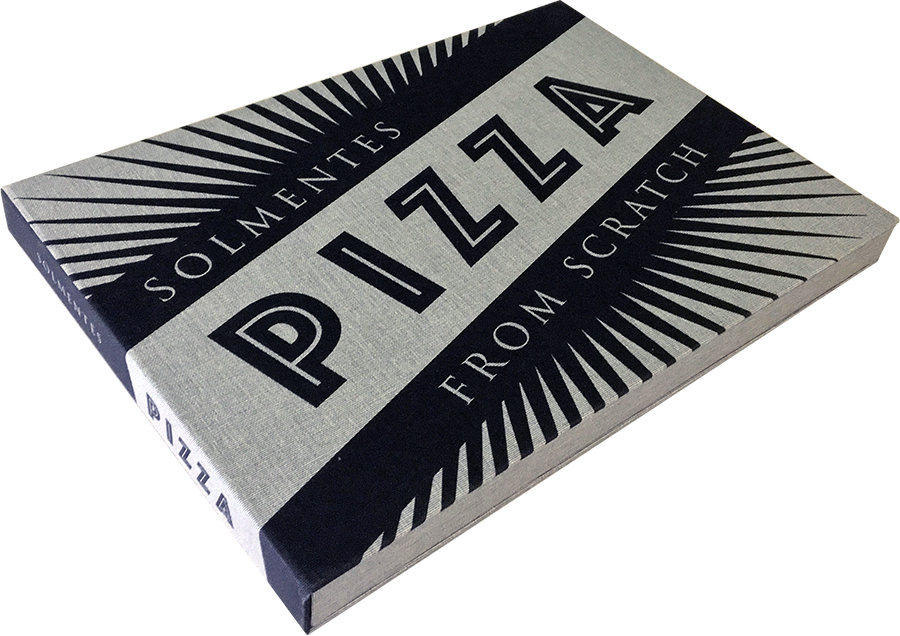
Pizza box

Binding

With the sorting, folding, gathering and collating I was able to clear some bench space in the workshop as the books were consolidated into three small piles. The book is offered in two variant bindings a “regular “ case binding and a “deluxe” full leather binding. Both bindings involve sewing by hand and each is presented in cloth-covered drop back box with the title printed on the spine and lid. Inserted into an envelope on the inside of the lid is a large folded print of the scale drawings for the oven.

I am pleased to report that “regular” Pizzas have been shipped to collectors in the US and the UK and I am particularly proud that both the British Library and the Library of Congress now have their copies. The deluxe bindings are almost finished.

Where to see Pizza from Scratch

A travelling exhibition is planned together with presentations and demonstrations and the book will be shown at book fairs in 2018 including the Manhattan Fine Press fair and the Oxford Fine Press Fair in March, and at the Oak Knoll Fest in Newcastle, Delaware in October. Full details of the book and all the images can be seen at solmentes.com

There is something magical about cooking in a wood-fired oven: the rolling flames, searing heat and tantalizing aromas are quixotic. If you’ve grown the ingredients, and harvested the tomatoes and basil that afternoon – the flavors will be out of this world.”


hot oven

***


Monday, March 6, 2017

How to get your books bound by the best bookbinders in the world

How serendipity led to Inside the Book playing a leading role as the set book in a new bookbinding competition. The Open•Set bookbinding competition is now a traveling exhibition and opens on Wednesday, March 8, 2017 in the University of Iowa Special Collections galleries, Iowa City (details below). I was one of the jurors and I am pleased to offer you an overview of the competition together with some insight into how my book came to be bound by some of the best bookbinders in the world.

Sol Rébora, 1st place, SET book, Inside the Book
📷American Academy of Bookbinding
I was pleased to meet Lang Ingalls, the chief organizer of Open•Set at a party in New York following the 2015 FPBA Manhattan Book Fair. She asked if I had any books in unbound sheets for a new competition . . . coincidentally I still had almost half the edition of Inside the Book.
"The OPEN • SET competition is a NEW triennial competition that formed in response to the burgeoning interest and palpable momentum in finely crafted design book bindings in the United States. Sponsored in part by the American Academy of Bookbinding, it is designed to encourage both new binders and professionals. OPEN • SET offers prizes and acknowledgement in two categories: Participants may choose to bind the SET book or a book of their choice, the OPEN category. Entries are limited to one book per category. Binders from all levels and cultures are invited to participate, as the competition is not limited to citizens of the United States nor to students or affiliates of the AAB. All entries will be reviewed by a blind jury of three professional binders. The three-member jury for the competition is: Eleanore Ramsey, David Esslemont, and Cathy Adelman."
Eleanore Ramsey, David Esslemont, and Cathy Adelman at
San Francisco Center for the Book Open•Set opening 📷Laine Tammer
My fellow jurors Cathy Adelman and Eleanore Ramsey both revealed an acute sensitivity and perspective in their appraisal and judgment – it was a pleasure to work with them, and we reached a consensus of opinion without recourse to distasteful argument.

Patricia Owen, 2nd place SET book, Inside the Book
📷 American Academy of Bookbinding
I am grateful Lang Ingalls and the American Academy of Bookbinding for not only choosing Inside the Book for their first competition, but also inviting me to be one of the jurors. Lang's vision, hard work, management skills and generous hospitality are unequalled and I congratulate her and the Academy for curating and presenting the Open•Set exhibition. It is, I think, quite simply, a stunning display of contemporary bindings.

The competition attracted entries from around the world from both professionals and new binders. We selected fifty books for the traveling exhibition including three prizewinners in each category and nine highly commended bindings.

Benjamin Elbel, 3rd place SET book, Inside the Book
📷 American Academy of Bookbinding
In the SET category we chose first: Sol Rébora (Argentina); second: Patricia Owen (USA); third: Benjamin Elbel (The Netherlands). We highly commended for tooling: Samuel Feinstein (USA); onlay and inlay: Susan Hulme (USA); use of materials Adeline Koh (Singapore).

In the OPEN category we chose first: Mark Esser (USA); second: Sofía Mendizabál (Argentina); third: Zigor Anguiano (Spain). We highly commended for titling: Jan Camps (Belgium); onlay and inlay: Coleen Curry (USA); endbands: Sol Rébora (Argentina); unusual materials [scalpel blades]: Sialia Rieke (USA); design: Dominic Riley (UK); unique structure: Luke Hornus (UK).

I doubt if anyone here knows the work of the dour and eccentric Scottish poet Ivor Cutler. His stories, such as ‘Gruts for Tea’ and ‘The Soup Tureen’ have long been favorites of mine. I met him once, at a book fair, and do you know what I said? "Hello, Billy, tea time, Gruts for tea" – I began reciting his poems, to his utter horror!

An ardent socialist, his own books were the most humble and unassuming productions you can imagine – more like chapbooks. At the time I was working for the Gregynog Press and suggested we might publish his work and showed him our finely-printed, leather-bound books – he was horrified and walked away muttering “this is so embarrassing, so embarrassing, I don’t understand . . .”

I tell you this story because when I saw the Open•Set exhibition in San Francisco, besides the pleasure of seeing the bindings again, now old friends so to speak, it was so embarrassing to see my name displayed alongside every single set-book binding. I’ve grown used to that now and feel honored and humbled to be bound by some of the best bookbinders in the world.

The opportunity to handle the books was an honor itself. How few people will enjoy that privilege? The best bindings in my view are those that are thoughtful, that function well and are appropriately dressed – bindings that stimulate both the aesthetic and haptic senses. In many cases the best bindings are happy books and this exhibition is full of happy books.


Inside the Book tells you how to make and publish a book in the twentieth, not the fifteenth century. Unlike the University of Iowa Special Collection’s Scriptores Historiae Augustae (the model for Greg Prickman's "Atlas of Early Printing"), only ten copies were offered in sheets. As a bookbinder, I knew there was a small market for unbound sets.

I did not intend the books to be kept in barrels under bookseller’s counters gathering grimy schmutztitels. My book was issued in a regular cloth binding together with ten copies in my own special “design” binding. However, due to my pecuniary state in 2002, I bound only half the edition – no wonder I was pleased to meet Lang Ingalls.

The lesson here is: although serendipity may intervene, you would be wise to bind the whole edition at once. This is even more important for those who are binding themselves, not only does it makes economic sense but also avoids that unfortunate circumstance where one asks, “how did I do that?" or "what am I to do now my chosen endpaper or book cloth is no longer available?”

Special binding by David Esslemont
But the curious thing is, Inside the Book and the Agustin History now have more in common than you would think. For example, both books can be found in many different bindings – in the case of Inside the Book, at least one hundred copies. Admittedly this is a far cry from the number of variant bindings of Lucile of which there are literally thousands, albeit from different publishers.

Also, there are questions surrounding the authorship of the History, with suggestions the authors were all fictitious. The careful reader will discover too that Inside the Book contains a work by a fictitious author. Like Lucile's author Meredith, Desmond Levista is in fact a pseudonym, just whose is up to you to find out.

The University of Iowa Libraries' copy of Scriptores Historiae Augustae,
printed in 1490, with a contemporary binding and foredge decoration from
the Pillone Library. 📷UI Special Collections
No coincidence either that I quote Thomas Carlyle in my Introduction: "The best effect of any book is that it excites the reader to self activity". In Sartor Resartus he reviews the fictitious Diogenes TeufelsdröckhSartor is a fascinating book and a long-term Solmentes project.

The idea for Inside the Book came about in 1998 following a panel discussion at an Oak Knoll Book Fest, in New Castle, Delaware at which Joel Silver, now director of the University of Indiana’s Lilly Library explained what kind of book he wanted to buy for his library. I noted he wanted a book that would be of interest to faculty, staff and students. During the flight from Philadelphia to Minneapolis I mapped out the contents of such a book and drew a sketch of the binding.


If anyone can cook, anyone can make a book is the premise that underlies the text.

At its simplest all you need is some kind of stylus and a substance on which to make marks, perhaps a pen and some paper. Raw materials, raw vegetables and fish or meat will make a meal. You can fry an egg on a hot rock. Food will cook in hot embers. The form of the book is constantly evolving and today there are many different ways to make a book. Although the digital book bears little resemblance to the medieval manuscript, they do in fact have a lot in common, they are still perceived as marks on a surface even if they are pixels. Maybe books of the future will be transmitted directly to our brains as data bits, bypassing the visual necessity of reading, who knows?

Inside the Book aims to inspire and offer the basic ground rules or tenets for making a physical book but it is not just concerned with designing and making the book. I also introduce the reader to the dirty world of commerce. I believe, if you offer multiple copies of a book for sale, then you are involved in publishing and publishing is a noble profession and it requires both editorial expertise and business acumen. Marketing and financial planning are essential parts of the publishing process and these topics are covered also, and I believe should become a standard part of the curricula of Book Arts courses.

Since Inside the Book is out of print, and the revised second edition and e-book are not yet available I encourage you to look for it in a library. I hope you’ll read it and enjoy the first chapters of the biblio novel by Desmond Levista that I used for specimen page settings. If you’re interested in reading about more about the creative process of writing and producing Inside the Book, take a look at another book: Ink on the Elbow, where in the course of our daily email correspondence over a period of four years, Gaylord Schanilec and I talk in detail about the books we are making. I still have a handful of bound of copies for sale.

I hope you enjoy the exhibition, and remember, if you want to get your book bound by some of the best bookbinders in the world: put aside 100 copies in sheets.

From March 8 to April 19, the exhibition will be at

Special Collections and University Archives
The University of Iowa Libraries
100 Main Library (LIB)
125 West Washington Street
Iowa City, IA 52242-1420
(319) 335-5921

Then travels to:

TELLURIDE • April 24 to May 20 AhHaa School of the Arts
117 North Willow Street, Telluride, Colorado
BOSTON • June 8 to July 19 North Bennet Street School
150 North Street, Boston, Massachusetts
AUSTIN • July 26 to August 26 Austin Public Library
710 West César Chávez Street, Austin, Texas

Links
Open•Set exhibition opening at UI Special Collections
Open•Set competition and exhibition (American Academy of Bookbinding)
Inside the Book, David Esslemont
"Gruts for tea", Ivor Cutler
The Atlas of Early Printing, Greg Prickman
The Lucile Project, Sid Huttner
Ink on the Elbow, David Esslemont and Gaylord Schanilec


Monday, March 7, 2016

Pizza from Scratch – Part 4


January 28–February 9: 'Burning Weeds', a hand printed, five-color lino cut, 24 x 12 inches.  At this stage neither the logistics of printing and binding or the format of the book have been resolved, but a page size of 10 x 12 inches (landscape) would accommodate this image as a double-page spread if trimmed to bleed.


Red, on orange on yellow,  and orange on yellow, 'wet on wet ink' proofs.


'Wheat Field', early morning, lino cut with watercolor wash, 24 x 12 inches. These double-page spreads convey the breadth of the landscape but printing them presents a challenge. Perhaps single-page images would make more sense . . . .


How about 12 x 7.5 inches? Here a close-up of the key block for a three-color lino cut, 'Cultivating' with the Massey Ferguson tractor.


This print of the key block is offset onto two other blocks, one each for red and green.


Obviously the Massey is red and the leaves and grass are green, where the two colours overlap they will produce a brown, ideal for the soil and tree trunks.


A first color proof shows how the red/green makes a brown, but it still needs work.


The wheat seeds viewed close up. This shows how the lino cut progresses, first cuts are rough outlines, followed by detailed hatching to add light and shade.


The finished block. For the book I might add a color wash or print black on a colored background.


Ten pounds of Glenn organic Spring wheat from Johnny's Selected Seeds in Maine where broadcast by hand.


To cover the seeds and compress the soil around them I drove around the field on the Kawasaki Mule dragging a vintage spike-tooth harrow. Two scarecrows and a totem pole will keep watch over the crop. (Key block)


Three-color lino cut with hand coloring. Now I wait for the seed to germinate and turn to the tomatoes which were planted earlier and may appear first in the book . . . . Read more in Pizza from Scratch – Part  5

Saturday, March 5, 2016

Pizza from Scratch – Part 3


January 12, 2015: Making adobe clay involves 'puddling' – the mixing of clay, sand and water with your feet, hence this pencil study. Drawing is an important discipline for the artist – daily practice is worthwhile. This post includes detailed studies as well as sketches for the illustrations to the Pizza book.


One of the main goals is to grow wheat for flour to make dough for the pizza. Here is a pencil drawing of an ear of Glenn organic Spring wheat grown on our farm here in Iowa.


The first step in preparing the field for planting was to burn last years weeds, with the hope that many of the weed seeds were also incinerated. At this point I began to think the book should be landscape format and this subject will become a double page spread lino cut.


Mixing cement and building concrete-block walls is hard, thirsty work, especially in the heat of the summer and the builder deserves a well-earned beer at the end of the day, especially when an important stage is completed. These walls will support a concrete plinth on which the oven will be built.


Wire mesh and tubing in place to reinforce the concrete slab.


Firebricks in position on top of an insulation layer, ready to build the sand dome around which the oven will be formed.


Drawing the sand dome to achieve the desired lighting was tricky.


My clay-covered hands forming the Adobe bricks.


Sharp-eyed viewers will observe the sand dome is covered with the Wall Street Journal. The newspaper is dampened and the hand-formed Adobe clay bricks are placed around the dome to form the first layer of the oven wall.


Preferred fuel: well-seasoned oak.

After almost three weeks drawing, it is time to embark upon a lino cut. Read more in the next post: Pizza from Scratch – Part 4

Thursday, February 25, 2016

Pizza from Scratch – Part 2


January 2016: Return to Pizza . . . a year later . . . the wheat has been harvested, a new pizza oven built and pizzas cooked, so the time has come to make the book. Working with colored markers I make storyboards of three-inch-square thumbnail sketches charting the progression of events.

Weeds, burning, charred remains, and cultivating
Since I began with the notion of clearing a field of weeds, and weeds are the subject of the woodcuts already completed (see Pizza – a work in progress) this will be my starting point. In these thumbnails  I envision a portrait-format book, with tall narrow pages, that opens to form a square – a useful frame for pizza.

Sowing seed, seedlings, scarecrow, harrowing
The organic Glenn spring wheat came from Johnny's Select Seeds in Maine.  Next, I chart the cultivation of heirloom Amish Paste tomatoes. The tomato seeds were planted before the wheat, so if the book is to progress chronologically these images should be first.


How to build the adobe clay wood-fired pizza oven will be explained with scale drawings and illustrations of key stages starting with gathering of all the necessary materials. This is the second pizza oven I have built, the first is documented in a post on September 2011: 'Recycling the East Side School – in a wood-fired clay pizza oven' and again on May 2012: 'Disaster – Wood-fired oven burns down'. Consequently it's construction will be considerably more robust!

Loading Iowa sand into the Dodge Ram 1500

Finished oven, blueprints, digging clay, puddling clay
The oven is formed, brick by brick, around a dome of sand covered in dampened newspaper.


Now the ideas are coming together, it is time to make more detailed drawings and studies for the prints. Follow the progress in Pizza from Scratch – Part 3

Tuesday, November 3, 2015

"Making Books, Chilli and Curry"

An illustrated talk on Thursday 5 November, by David Esslemont to The Bewick Society: Newcastle City Library, Charles Avison Building, 33 New Bridge St W, Newcastle upon Tyne, England, at 6.30 p.m.


"There is much here in the Northeast that is relevant to what I want to talk about tonight. I have an interest in books. You have an interest in books. Actually, I find many people have an interest in books of some sort.
  I also have an interest in food – and I’ve found that everybody has an interest in food. I think chefs and book designers have a lot in common. We are designing, creating, directing – orchestrating – a wide range of different elements, and overseeing their production, often as multiples. Aren’t we both obsessed with detail, with the quality of the materials or ingredients, the production, the presentation . . .? Aren’t we looking for that perfect balance?
  Tonight I am going to talk about creativity, inspiration, and how our heritage, and our traditions, hindsight and insight help shape the work we create . . ."

To book a FREE ticket: Telephone 0191 277 4100 or book online

Sunday, November 1, 2015

Printing, Type and Typographical Design

Oxford Bibliographical Society, Taylor Institute
Monday, 2 November at 5.15 p.m.
An illustrated talk 'To my bibliographer: notes, observations & anecdotes about books I have printed (or intend to), pertaining to Bewick, Carlyle, Chili, Curry, Keats, Levista, War and Wordsworth.'


" . . . Minutiae are the bread and butter of both bookmaker and bibliographer. A myriad seemingly trivial and mundane details all need careful consideration. I’m interested those details, those decisions that ultimately coalesce into books, books that function, books that are not only a joy to read, but also a delight to all the senses and in Carlyle’s words “excite the reader to self activity”. I’m interested in publishing too, because a book without a reader is worthless, isn’t it? And, like Philip Gaskell I believe the techniques of printing are key to understanding how a text comes into existence.
  My bibliographer is compiling a descriptive catalogue, so let’s see if I can help with a few crumbs from the table, so to speak, by considering some of the books I’ve printed since first becoming acquainted with the caduceus of Hermes.
  To flesh out these mundane details I’m including some anecdotal evidence, which, I hope the bibliographer will find useful and you will find entertaining. . . . "

Taxi Driver Curry at the Oxford Fine Press Book Fair

On Saturday 31 October and Sunday 1 November 2015, at Oxford Brookes University, Headington Campus, Gipsy Lane, Oxford, England

Solmentes at the 2015 Oxford Book Fair 
Taxi Driver Curry is now published and available in regular and deluxe bindings (see above, displayed together with New York Revisited). The book is described in a previous post

The Oxford Fine Press Book Fair is organized by The Fine Press Book Association in collaboration with the Provincial Booksellers Association 
Saturday, 31 October 11am to 6pm, and Sunday, 1 November 10am to 5pm.

Featuring  98 exhibitors including private presses from the UK, the Americas, Russia, Asia, and continental Europe, as well as dealers in fine press books, suppliers of fine printing materials, and related societies:.

Podcast: David Esslemont on the history of the Gregynog and Solmentes Presses

Gregynog Hall Nigel Beale aka The Literary Tourist , came to visit and recorded our conversation in which he asked me about the history...